References Used (Alphabetical Listing):
Please note that only starred (*) references will be fully annotated. Additional references are intended to guide further reading or viewing should a particular topic be of interest, or to provide a variety of opinions, but explanations will be much briefer than the formal Annotations.
In the next section, I will the place the Annotated References in the order I suggest they be read, along with which Additional References I recommend to complement the main reading(s).
Articles and Books
Arabena, Kerry (2006). The Universal Citizen: an Indigenous citizenship framework for the twenty-first century. Australian Aboriginal Studies, 2. 36-46.
*Bartlett, Albert A. (1994). Reflections on sustainability, population growth, and the environment. Population & Environment, 16 (1), 5-35.
*Clarkson, Linda, Morissette, Vern & Régallet, Gabriel (1992). Our Responsibility to the Seventh Generation. Winnipeg: International Institute for Sustainable Development. Retrieved from http://www.iisd.org/7thgen/default.htm June 6, 2010
*Hardin, G. (1968). Tragedy of the commons. Science, 162 (3859), 1243 – 1248.
*Inayatullah, Sohail. (2010). Spirituality as the Fourth Bottom Line. Retrieved from http://www.metafuture.org/Articles/spirituality_bottom_line.htm June 6, 2010.
Kates, R., Parris, T., & Leiserowitz, A. (2005). What Is Sustainable Development?. Environment, 47(3), 8-21. Retrieved from Environment Index database June 6, 2010.
Laff, M. (2009). Triple Bottom Line. T+D, 63(2), 34-39. Retrieved from Academic Search Complete database.
*Lovins, Amory B., Lovins, L. Hunter & Hawken, Paul (2007). A Road Map for Natural Capitalism. Harvard Business Review, 85 (7/8) 172-183.
*McMichael, Anthony J. (2008). 20 Years: Into our Common Future. Environment, 50 (1), 46-59. Retrieved from Academic Search Complete database May 26, 2010.
Mitchell, Michael, Curtis, Allan & Davidson, Penny. (2008). Evaluating the process of triple bottom line reporting: Increasing the potential for change. Local Environment (13) 2, 67-80.
*Norman, Wayne & MacDonald, Chris (2004). Getting to the bottom of “Triple Bottom Line”. Business Ethics Quarterly, 14 (2), 243-262.
Okello, Moses Makonijo, Seno, Simon K. Ole, Nthiga & Rita Wairimu (2009). Reconciling people's livelihoods and environmental conservation in the rural landscapes in Kenya: opportunities and challenges in the Amboseli landscapes.
*Rees, William E. (1990). Ecology of sustainable development.
The Ecologist 20 (1), 18-23.
Ross, Andrea (2009). Modern interpretations of sustainable development. Journal of Law & Society, 36 (1), 32-54.
Shiva, V. (2005). Earth democracy: Justice, sustainability, and peace. Cambridge, MA : South End Press.
Veteto, James R., and Lockyer, Joshua. (2008). Environmental Anthropology Engaging Permaculture: moving theory and practice toward sustainability. Culture and Agriculture 30 (1-2). 47-58.
Websites
When it comes to films, videos and websites, most if not all of those listed by Catherine in “Resources for Ecological Leadership for Educators” have something relevant to sustainability. This goes for the Key Concepts as well. Even if sustainability is not mentioned by name, most of the principles, behind, for instance, organic farming, permaculture, biodiversity, seed saving, conservation, ecological footprint, food security and water security, off the grid alternatives, renewable energy sources, traditional ecological knowledge, reducing greenhouse gas emissions and climate change etc., etc., have to do with creating a more sustainable future. Strategies to get there may differ slightly, but the goal is the same.
Some of the most relevant to sustainability directly included:
United Nations Brundtland Report:
Retrieved June 14, 2010
(no page #s).
Brundtland – scanned original at:
Retrieved: June 14, 2010.
Metafuture.org
http://www.metafuture.org/
Retrieved: June 14, 2010
SD Gateway Website
Retrieved May 26, 2010
SD Gateway Presentation:
Retrieved May 26, 2010
UVic Sustainability Office http://web.uvic.ca/sustainability/newsservice.php
Retrieved June 4, 2010
Shiva, Vandana. (2002/2003) Earth Democracy - Ten Principles of Justice, Sustainability and Peace. A supplement to EarthLight Magazine (47), Fall/Winter 2002/03. Retrieved from: http://www.earthlight.org/2002/essay47_democracy_pff.html June 6, 2010.
Films / Internet-based Video
Achbar, Mark (Director & Producer) & Abbott, Jennifer (Director) & Simpson, Bart (Producer). (2003). The Corporation. [Motion Picture]. Canada: Big Picture Media Corporation.
Image retrieved June 16, 2010 from: http://en.wikipedia.org/wiki/File:Movie_poster_the_corporation.jpg
Anderson, Ray. (2010, May 16). Ray Anderson on the business logic of sustainability. [Video file]. Video posted to: http://www.ted.com/talks/lang/eng/ray_anderson_on_the_business_logic_of_sustainability.html
Arthus-Bertrand, Yann (Director) & Besson, Luc (Producer). (2009; viewed June 3. 2010). Home [Video file]. Video posted to: http://www.youtube.com/watch?v=jqxENMKaeCU
Image retrieved June 6, 2010 from: http://api.ning.com/files/MPshmX4ldZ1uBqL0wnPmwvl5I*NyCp89QTzIeMGs4RpaSVik6AwfHIam7AMR6gMIffGf3ZKiYIkknw56O9V74f82bxl-XtwA/yann_arthus_bertrand.jpg
Baichwal, Jennifer (Director & Producer) & de Pencier, Nick & Iron, Daniel (Producers). (2006). Manufactured Landscapes [ Motion Picture]. Canada: Mercury Films Inc and Foundry Films Inc.
Image retrieved June 16, 2010 from: http://en.wikipedia.org/wiki/File:ManufacturedLandscapes.jpg
Barber, Dan. (2010, May 16). How I fell in love with a fish. [Video file]. Video posted to
Benyus, Janine. (2010, June 6). Janine Benyus shares nature’s designs. [Video file]. Video posted to: http://www.ted.com/talks/lang/eng/janine_benyus_shares_nature_s_designs.html
Image retrieved June 16, 2010 from: http://en.wikipedia.org/wiki/File:Aninconvenienttruth.jpg
Hopkins, Rob. (2010, June 6). Transition to a world without oil. [Video file]. Video posted to: http://www.ted.com/talks/lang/eng/rob_hopkins_transition_to_a_world_without_oil.html
Kenner, Robert (Producer/ Director) and Pearlstein, Elise (Producer). (2008). Food Inc. [Motion Picture]. United States: Magnolia Pictures.
Image retrieved June 16, 2010 from: http://en.wikipedia.org/wiki/File:Food_inc.jpg
Lerner, Jaime. (2010, June 14). Jaime Lerner sings of the City. [Video file]. Video posted to: http://www.ted.com/talks/lang/eng/jaime_lerner_sings_of_the_city.html
Morgan, Faith (Director and Producer), Blessing, Thomas E. IV., Murphy, Eugene, & Quinn, Megan (Producers). (2006). The Power of Community: How Cuba Survived Peak Oil. United States: The Community Solution.
Image retrieved June 16, 2010 from: http://en.wikipedia.org/wiki/File:Power_of_Community-_How_Cuba_Survived_Peak_Oil_Pocposter1.jpg
Steffen, Alex. (2010, June 6). Alex Steffen sees a sustainable future. [Video file]. Video posted to: http://www.ted.com/talks/lang/eng/alex_steffen_sees_a_sustainable_future.html
Shiva, Vandana. (2010, June 9). The Future of Food – Part 1 of 3. [Video file]. Video posted to: http://www.youtube.com/watch?v=vi1FTCzDSck
Shiva, Vandana. (2010, June 9). The Future of Food – Part 2 of 3. [Video file]. Video posted to: http://www.youtube.com/watch?v=TVlJqwft9I8
Shiva, Vandana. (2010, June 9). The Future of Food – Part 3 of 3. [Video file]. Video posted to: http://www.youtube.com/watch?v=PQDqEUd53YQ&NR=1
Shiva, Vandana. (2010, June 9). Seeding Deep Democracy. [Video file]. Video posted to: http://www.youtube.com/watch?v=dsK3V04LAvw
Image retrieved June 16, 2010 from: http://www.ecofriendlymag.com/wp-content/plugins/wp-o-matic/cache/30c7d_20090618-vandana-shiva.jpg
Also check out this website and the book from which it is derived: Shiva, Vandana. (2002/2003) Earth Democracy - Ten Principles of Justice, Sustainability and Peace. A supplement to EarthLight Magazine (47), Fall/Winter 2002/03. Retrieved from: http://www.earthlight.org/2002/essay47_democracy_pff.html June 6, 2010.
References in Recommended Order with Suggested “Pairings”
Step 1: Background = the Base
Most research today begins with a basic “Google” search of terms of interest, and the definitions and history of sustainability should be no exception. This will provide an overview to help focus further research as well as provide insights into just how many different interpretations of “sustainability” there are.
One of the biggest threats to sustainability is the build-up of greenhouse gas (GHG) emissions which is causing unprecedented climate change around the world. There are probably thousands of websites devoted to this topic. To help make the topic more accessible to students, two films that provide a solid overview of the causes and effects of climate change, as well as the politics involved are An Inconvenient Truth and Home (below).
Guggenheim, Davis (Director), & Bender, Lawrence, Burns, Scott Z., & David, Laurie (Producers) (2006). An Inconvenient Truth [Motion Picture]. USA: Paramount Classics.
Website: http://www.climatecrisis.net/
Arthus-Bertrand, Yann (Director) & Besson, Luc (Producer). (2009; viewed June 3. 2010). Home [Video file]. Video posted to: http://www.youtube.com/watch?v=jqxENMKaeCU
Website: http://www.home-2009.com/us/index.html
Invariably, most histories of sustainability begin their story with the United Nations Brundtland Report. Most articles and websites provide a good overview of this report, but if you would like to see the original, two website are useful. The first is the text in html format, so there are no page numbers for referencing. The second is a scanned pdf of the report:
Brundtland, G.H. (1987). Our Common Future. World Commission on Environment and Development. New York: Oxford University Press. Retrieved from: http://www.un-documents.net/ocf-01.htm#I June 14, 2010.
(no page #s)
Brundtland Report (same as above) – scanned original at:
Retrieved from: http://daccess-dds-ny.un.org/doc/UNDOC/GEN/N87/184/67/IMG/N8718467.pdf?OpenElement June 14, 2010.
This Cartoon demonstrates a common criticism of Brundtland and other “solutions” by wealthy nations:
Image retrieved June 16, 2010 from: http://www.socialjustice.org.nz/images/economic/53be0be5.png
Hardin, G. (1968). Tragedy of the commons. Science, 162 (3859), 1243 – 1248.
I consider the Hardin (1986) reading, “Tragedy of the Commons”, to be part of the background necessary to explore the topic of sustainability. He wrote this article with the intention of proving that “the population problem has no technical solution; it requires a fundamental extension in morality” (p. 1243). He argues that “a finite world can support only a finite population; therefore, population growth must eventually be zero” (p. 1243). While many would argue his suggested solutions of, for instance, governments “coercing” people into having fewer children (p. 1247), his overall message that “we can never do nothing. That which we have done for thousands of years is also an action. It also produces evils” (p. 1247) is relevant to concerns over how we need to act to create a sustainable world. His work is often cited in discussions related to sustainability, and as such it is important to have a clear understanding of what the “tragedy of the commons” is. For instance, Barbara Kingsolver (2010) in her National Geographic article “Water is Life” refers to water as “the ultimate commons”, and discusses Hardin directly (http://ngm.nationalgeographic.com/2010/04/water-is-life/kingsolver-text/5
Retrieved June 26, 2010). (The remainder of this is adapted from my Moodle Post of May 21, 2010).
The first step in understanding the tragedy of the commons is to understand what “the commons” is. The “commons” seems refer to common areas or resources that are shared by a society or community. Everyone has equal access to his or her “share”.
Hardin’s “Tragedy of the Commons” is that it seems to be an “inevitability” or “destiny” that when multiple individuals share a resource, they cannot help but act in self-interest, trying to “maximize their gains” by getting the most out of their share.
On an individual level this may not seem problematic (and this is indeed the basis of our capitalist society…), but when everyone behaves with the same self-interest, the common resource ends up being depleted and everyone is harmed rather than helped in the long run. As way of example he uses the scenario where herdsmen sharing a common pasture can sustain their herds as long as things like disease, poaching and tribal wars keep the number of animals consistent with the carrying capacity of the land (p. 1244). However, each tribesman “naturally” wants to add more animals to their herd to maximize their own gain without considering the negative impact of overgrazing, which could put all herdsmen at risk of losing everything (p. 1244).
Hardin seems to believe that when left to their own devices, people will always put themselves first so that over-exploitation, and eventually, destruction, of the resource will result. He believes that unlimited, free access to finite resources cannot work and there needs to be some form of control – such as government regulations that “coerce” more restrained behaviours and reduce exploitation of the Commons.
This article is especially useful for teachers in their background knowledge but it could also be used – in whole or in excerpts, to assist senior high school students, or, of course, post-secondary students, look at the issues of sustainability in a critical way.
In addition to the article, I discovered some wonderful cartoons that could enhance a lesson using Hardin’s article:
Cartoons illustrating The Tragedy of the Commons
#1
#2
Step 2: Going Deeper
TOPIC: Different Interpretations of and
Approaches to Sustainability
Image retrieved June 17, 2010 from: http://www.wmei.ws/Pictures%20on%20site/world%20in%20hands.jpg
In “20 Years: Into Our Common Future”, McMichael (2008) provides a critical analysis and assessment of the Brundtland Report. This is a valuable resource due to how much the report is cited in other references as well as the fact that this report brought the term “sustainable development” (SD) into the mainstream. While the definitions of SD in the report are often criticized for being too vague, they are the base upon which most other definitions rest.
McMichael examines whether the goals of the report have been achieved or are in the process of being achieved, and why. He also analyses the historical context of Brundtland: what were the widely-held assumptions, views, beliefs, and understandings about the links between population growth, resources, health, and the environment - and therefore sustainability - at the time?
He asserts that there was too narrow a focus placed on the concern over how to preserve economic development while also achieving environmental sustainability, and too little attention was given to the human element of sustainability. There was little appreciation at the time, for instance, of the link between factors affecting the environment such as climate change and the effects it would have on human health. He states that the report overlooked
the fundamental role that sustaining an intact biosphere and its component systems plays in enabling the social and human developmental processes that can reduce poverty, undernutrition, unsafe drinking water, and exposure to endemic and epidemic infectious diseases. The report, if written today, would seek a better balance between these sets of relationships (p. 58).
This is a valuable resource for teachers and could also be used with senior secondary and post-secondary students to demonstrate the complexities of SD and how and why it is challenging to implement.
*Rees, William E. (1990). The Ecology of Sustainable Development.
The Ecologist 20 (1), 18-23.
Image retrieved June 11, 2010 from: http://www.plu.edu/sustainability/images/url.png
In The Ecology of Sustainable Development, William Rees (1990) argues that when the term “sustainable development” became popular, it also lost its original meaning which was to help ensure the world’s future ecological stability. It has repeatedly been used politically as an excuse for continued economic growth rather than serving as a means to encourage restraint in the name of what is best for the environment. As he states, “true sustainability demands a radically different economics which fully recognizes the processes and limits to the biosphere” (p. 18).
Rees very clearly outlines how and why our developed societies have created the current “reality” (p. 18) that we find ourselves in: seeing the environment as separate from humans, “as a source of resources and a sink for wastes” (p. 19), that can be “fixed” by technology if need be (p. 19). However, as he states, “there is only a single entity, the biosphere, and humanity has always been part of it” (p. 19)). Our cultural perception of reality is in direct opposition to the ecological reality of how ecosystems function and how unlimited growth in a finite world is both impossible and unsustainable. He also clearly explains how we may have already exceeded our global carrying capacity (p. 20-21). This is in part due to inter-regional trade which “import[s] ecological goods and services [which] means importing carrying capacity from elsewhere and encourages people to destroy their own local ecosystems through ‘development’ at no apparent cost to themselves” (p.22).
Finally Rees summarizes the principles he believes should serve as “guidelines on the road to sustainable development” (p. 21). There are too many to mention here, and while not necessarily easy to implement, all are well-reasoned. One of the most important is that “rates of waste must be limited to the rate at which ecosystems can absorb and degrade the wastes” (p. 21), which includes a “zero tolerance” for “carcinogens and similar dangerous compounds” (p. 21).
This article is crucial reading for teachers and could be used in whole or in part with students to provide them with a clear, well-reasoned look at what SD should really be and what is required of people to achieve it.
Ross, Andrea (2009). Modern interpretations of sustainable development. Journal of Law & Society, 36 (1), 32-54.
This article by Ross is another great overview of the history and complexities of sustainable development. It serves as an excellent accompaniment to Rees (1990), as well as the annotated articles relating to sustainability in business (next section, below).
Kates, R., Parris, T., & Leiserowitz, A. (2005). What Is Sustainable Development?. Environment, 47(3), 8-21. Retrieved from Environment Index database June 6, 2010.
This article provides a comprehensive overview of the history of the SD term and explores the ways it could be more clearly defined: by the goals SD seeks to achieve, by how SD is measured (“indicators”), by the values that represent or support SD, or by how SD is practiced. While Kates et al. provide no conclusion on how SD should be defined, they believe “each definitional attempt is an important part of the ongoing dialogue” (p. 20).
Image retrieved June 17, 2010 from: http://www.scientificamerican.com/media/inline/population-and-sustainability_1.jpg
Bartlett (1994)’s article is an interesting one because it is equally useful and problematic at the same time. Bartlett takes issue with the fact that Brundtland’s definition of “sustainable development” does not lay out a clear course of action, and therefore he very carefully presents a series of “logical” laws and hypotheses to help clarify the term and the implications that follow from them.
Some of his points provide exposure to excellent arguments and useful terms, many of which support Rees (1990) and Ross (2009)’s points about the need for ecological sustainability. He indicates, for instance, that “the finite size of resources, ecosystems, the environment, and the Earth lead one to recognize that the term ‘sustainable growth’ is an oxymoron” (p. 7). One term in particular that stood out for me was the idea of “technological optimists” who “believe that the human mind has unlimited capacity to find technological solutions to all problems of crowding, environmental destruction, and resource shortages” (p. 28), which is not realistic. He also points out that “politicians and business people tend to be eager disciples of the technological optimists” (p. 29), which calls attention to a large part of the reason governments and businesses have not acted more quickly and comprehensively to address environmental concerns.
Image retrieved June 6, 2010 from: http://www.krankyscartoons.com/images/Growth_Versus_Sustainability.jpg
Though problematic, it is important for educators to be aware of alternate arguments or ways of viewing the SD issue so that they can address them head-on. This is a useful article for teachers and could be used to help students see how “logic” can also be used to manipulate facts when information is omitted or presented in a biased manner.
Baichwal, Jennifer (Director & Producer) & de Pencier, Nick & Iron, Daniel (Producers). (2006). Manufactured Landscapes [ Motion Picture]. Canada: Mercury Films Inc and Foundry Films Inc.
As the website (above) describes: “MANUFACTURED LANDSCAPES is the … documentary on the world and work of renowned [Canadian] artist Edward Burtynsky. Internationally acclaimed for his large-scale photographs of “manufactured landscapes”—quarries, recycling yards, factories, mines and dams—Burtynsky creates stunningly beautiful art from civilization’s materials and debris. The film follows him through China, as he shoots the evidence and effects of that country’s massive industrial revolution. With breathtaking sequences, such as the opening tracking shot through an almost endless factory, the filmmakers also extend the narratives of Burtynsky’s photographs, allowing us to meditate on our impact on the planet and witness both the epicenters of industrial endeavor and the dumping grounds of its waste.
In the spirit of such environmentally enlightening sleeper-hits as AN INCONVENIENT TRUTH and RIVERS AND TIDES, MANUFACTURED LANDSCAPES powerfully shifts our consciousness about the world and the way we live in it, without simplistic judgments or reductive resolutions.” (retrieved June 27, 2010).
Image retrieved June 16, 2010 from: http://www.iisd.org/7thgen/main.gif
Accompanying website very useful as well: http://www.iisd.org/
This book, available online, was written on behalf of the International Institute for Sustainable Development (IISD) to outline the relationship between indigenous people and the sustainable development movement. This relationship includes the complexities of the racism and marginalization that have been inflicted on indigenous people in Canada and across the world, and so their call to ensure responsibility to the seventh generation is just as much about ensuring justice and equity as it is about saving the environment. This book is an excellent resource to provide teachers with an overview of indigenous perspectives of the environment especially the concept of seven generation planning. It is also a useful tool for exploring intersectionality.
The first chapter of the book sets the stage by providing an overview of the barriers to understanding Indigenous perspectives, especially the ethnocentric way the dominant society views the world. The second chapter explains the Indigenous perspective and relationship with the environment, including the roots in “an intimate awareness of [their] symbiotic relationship to the earth, based upon a delicate balance between its living parts” (p. 7). This chapter also explains the belief that it is the “sacred responsibility of Indigenous people to be the caretaker of all that is on Mother Earth and therefore that each generation is responsible to ensure the survival for the seventh generation” (p. 7), which in turn has influenced Indigenous institutions and systems such as the extended family system and decision-making through consensus (p. 7).
Chapter three outlines the processes of impoverishment and marginalization that were used to disrupt traditional economies and cause social degradation, including the marginalization of women and youth in particular. It reviews the effects of assimilation and “modernization” including the effects of residential schools and discriminatory laws. This chapter also “exposes why Indigenous peoples have been socially and environmentally destroyed by development schemes” due to “colonialism, the early integration into the global economic system, and the ongoing application of inappropriate development strategies [which] have eroded the strength of traditional societies and radically transformed the Indigenous way of life” (p. 8).
Chapter 4 concentrates on the need for Indigenous and non-Indigenous people to understand the negative processes of the past and present and to find ways to heal. It is emphasized that Indigenous people must create their own mechanisms of change and existing barriers need to be removed to make this happen – especially regarding access and control over land.
Chapter 5 highlights that Indigenous knowledge is local knowledge, which has been “adapted to the culture and the ecology of each population and matured over a very long period of time”, as well as “in compliance with natural law and is based on a holistic vision of life” (p. 9). Also, the fact that Indigenous societies have survived despite great adds and adversity demonstrates that we have a lot to learn from their social organization.
The final chapter is a call to action and provides guiding principles for change that will, by helping Indigenous people heal, also help non-Indigenous people who will benefit from “the strengthening of the potential to save ourselves from global destruction” (p. 9).
Arabena, Kerry (2006). The Universal Citizen: an Indigenous citizenship framework for the twenty-first century. Australian Aboriginal Studies, 2. 36-46.
This article is a good accompaniment to Clarkson et al. (1994). It provides a comprehensive overview of Indigenous perspectives as they relate to sustainability issues, and in particular suggests that the answer to our present-day crisis may be to follow Indigenous examples by re-connecting with nature and becoming “Universal Citizens”.
Shiva, Vandana. (2010, June 9). The Future of Food – Part 1 of 3. [Video file]. Video posted to: http://www.youtube.com/watch?v=vi1FTCzDSck
Shiva, Vandana. (2010, June 9). The Future of Food – Part 2 of 3. [Video file]. Video posted to: http://www.youtube.com/watch?v=TVlJqwft9I8
Shiva, Vandana. (2010, June 9). The Future of Food – Part 3 of 3. [Video file]. Video posted to: http://www.youtube.com/watch?v=PQDqEUd53YQ&NR=1
Shiva, Vandana. (2010, June 9). Seeding Deep Democracy. [Video file]. Video posted to: http://www.youtube.com/watch?v=dsK3V04LAvw
Shiva, Vandana. (2002/2003) Earth Democracy - Ten Principles of Justice, Sustainability and Peace. A supplement to EarthLight Magazine (47), Fall/Winter 2002/03. Retrieved from: http://www.earthlight.org/2002/essay47_democracy_pff.html June 6, 2010.
In the above videos and website, Shiva discusses issues relating to concerns about food security, genetically modified foods, seed saving, the patenting of seeds and other life forms, biodiversity conservation, “ecocide” through the use of herbicides, biopiracy, and many other issues that are either hurdles to or could be the answers to, ecological sustainability in the world. Because much of her commentary focuses on the importance of giving Indigenous populations greater control and rights over the food and water that they need to survive, these videos are a good accompaniment to the readings on Indigenous perspectives.
TOPIC:
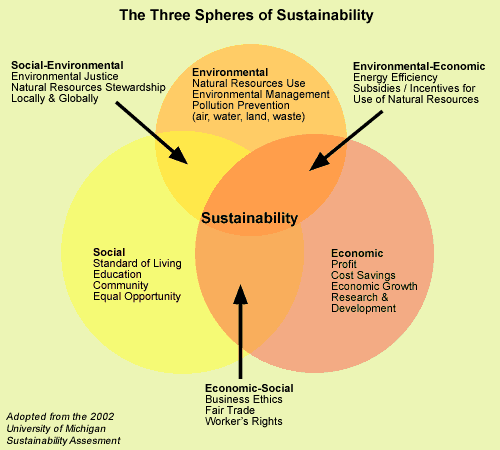
Sustainability as it relates to businesses, the Triple Bottom Line (3BL) and Quadruple Bottom Line (4BL)
The resources in this section examine how businesses could resolve the tension between achieving a balance between financial profitability and environmental sustainability. While there is no magic formula for finding the perfect balance, it is encouraging that this dialogue is now in the mainstream and that there are efforts to make structural changes that can have a wider-scale impact on the well-being of the planet. Corporations play a large role in our economies but more importantly in our politics: governments often create or change policies and laws based on pressure from corporations, either directly or through special interest groups who work for big business and industries. The more businesses that lead the way to more sustainability, the more governments will follow up with laws that compel the general population to do the same.
Image Retrieved June 11, 2010
*Norman, Wayne & MacDonald, Chris (2004). Getting to the bottom of “Triple Bottom Line”. Business Ethics Quarterly, 14 (2), 243-262.
There are many articles that outline the popularity of businesses using the “Triple Bottom Line (3BL)” to demonstrate their commitment to “sustainability”, which is described by Norman and MacDonald (2004) in this way: “The idea behind the 3BL paradigm is that a corporation’s ultimate success or health can and should be measured not just by the traditional financial bottom line, but also by its social/ethical and environmental performance” (p. 243). While they “assume without argument both the desirability of many socially responsible business practices, on the one hand, and the potential usefulness of tools that allow us to measure and report on performance along these dimensions” (p. 244), they believe that ultimately the 3BL is mostly rhetoric, inherently misleading, and cannot deliver on its promises.
Their main issue with the 3BL term is that it implies that the three aspects can be clearly measured, like a traditional financial bottom line. However, the authors assert that 3BL is impossible to measure, and therefore, nothing but jargon. For instance, they go into quite a bit of detail on how and why social measures are impossible to quantify. They ask the question: how do you convert “good” deeds and “bad” deeds into net gains or net losses? (p.252). So for instance, does giving one million dollars to a local charity (“good”) outweigh polluting a local river with industrial waste (“bad”)? Or even more difficult, how do you decide which is “better” between two good deeds or “worse” between two bad deeds? (p. 252-254).
Other researchers, such as Mitchell et al. (2008) (see below) argue that the reporting of 3BL per se is not what is valuable or important. What should be focused on is “what is being learned through the process, the capacity- and relationship-building that might eventuate, and how this impacts on the development of sustainability” (p.67). In other words, the process is more important than the reporting. However, Norman and MacDonald feel the term simply should not be used unless social and environmental criteria can be clearly measured – which they say, it cannot.
This is a useful article for teachers to acquire background on 3BL and its problematic aspects. It could be used in whole or in part to lead discussions or debates about the usefulness and validity of the term.
Image Retrieved June 16, 2010
From:
Mitchell, Michael, Curtis, Allan & Davidson, Penny. (2008). Evaluating the process of triple bottom line reporting: Increasing the potential for change. Local Environment (13) 2, 67-80.
Referenced in Norman and McDonald’s annotation (above).
Laff, M. (2009). Triple Bottom Line. T+D, 63(2), 34-39. Retrieved from Academic Search Complete database.
This is a straightforward article about the Triple Bottom Line (3BL) and provides several corporate examples of companies using more sustainable practices such as Interface. Its drawback is it focuses too much on the positive without enough balanced reporting about the drawbacks of 3BL.
Image retrieved June 16, 2010 from: http://sptvsfnd.files.wordpress.com/2008/09/spirituality-pict-blog1.jpg
Inayatullah, Sohail. (2010). Spirituality as the Fourth Bottom Line. Retrieved from http://www.metafuture.org/Articles/spirituality_bottom_line.htm June 6, 2010.
Building on the understanding of businesses using the Triple Bottom Line (3BL) to assess their overall performance and progress, this article provides teachers with a solid overview of the “Fourth Bottom Line”: spirituality. Much of the article outlines some of the reasons why businesses are attracted to this new way of defining success for their organization. These include changing values of stakeholders (not just stockholders), such as employees wanting to work for a company they can be proud of or a company’s ability to attract and retain talent (which also relates to the original bottom line)(para 2 of “Times have Changed”). It can also involve CEOs leading the change due to life experiences that have changed their values as well as realizing that they actually stand to make greater profits by being more self-reflective and conscious of their impacts on the wider community and world (para 3, “Times Have Changed”).
Interestingly, this article addresses head on Norman and MacDonald’s (2004) main concern of the immeasurability of concepts such as social and environmental well-being and spirituality. Unlike Norman and MacDonald, Inayatullah (2010) does not see the measurement challenge as a reason to dismiss or give up on the idea. He acknowledges that attempting to measure spirituality is not just difficult but actually dangerous in some respects:
Languaging the Transcendent more often than not leads to genderizing, and thus immediately disenfranchises half the world’s population. Along with the problem of patriarchy, comes the problem of caste/class, elite groups claiming they can best interpret the transcendental. The transcendent becomes a weapon, linguistic, political, economic; it becomes a source of power and territory, to control (para 9 of “Times Have Changed”).
The approach he suggests involves taking a layered view of spirituality through the metaphor of an iceberg. Those parts above the water are easier to see and measure (i.e. physical practice such as meditation) while the deeper one goes, “measurement becomes more problematic, and the deepest is of course impossible to measure” (para. 11 of “Times Have Changed”). Overall, while he offers some suggestions and guidance to how measurement of spirituality can be structured, he does not claim to have a simple answer. He states, “what is clear is that the spiritual is becoming part of a new world paradigm of what is real, what is important. What is needed is a debate on indicators that can evaluate this new paradigm in process” (final para. Of “Measures”).
Image retrieved June 16, 2010 from: http://hbr.org/hbrg-main/resources/images/site-programming/homepage/hbr-classic/010109-classic-lovins.jpg
In “A Road Map for Natural Capitalism” Lovins et al. (2007) emphasize the need for businesses to recognize and act on the links between the environment / biosphere and the economy. They explain that historically industries have looked “only at the exploitable resources of the earth’s ecosystems – its oceans, forests, and plains – and not at the larger services that those systems provide for free” (p. 174). As such, industries end up harming the very systems they need to benefit them economically by doing things that interfere with the ecosystem’s ability carry out its functions (“vital services”). This, they argue makes it the imperative of government and industries to engage in what they call “natural capitalism” – a kind of capitalism that properly values the “natural capital” of ecosystem services (p. 174). Overall, this will not only help the environment, but also improve profits now and in the future.
Lovins et al. believe that making the shift to natural capitalism involves “some very simple changes to the way we run our businesses” (p. 174). The first step is to “dramatically increase the productivity of natural resources”, or reduce the amount of wastefulness and destruction of resources in which businesses typically engage (p. 174). The second step is to “shift to biologically inspired production models”, (i.e. biomimicry) or “eliminate the very concept of waste” by using “closed-loop production systems, modeled on nature’s designs, [where] every output either is returned harmlessly to the ecosystem as a nutrient, like compost, or becomes an input for manufacturing another product” (p. 174). The third step is to “move to a solutions-based business model”, such as providing services instead of products that will be thrown away. One example of this is the Interface carpet company that leases carpets. They provide the service of upkeeping the carpet so that they can simply repair worn areas and recycle those that need to be replaced, which eliminates waste. The last step is to “reinvest in natural capital”. Here they insist, “businesses must restore, sustain, and expand the planet’s ecosystems so that they can produce their vital services and biological resources even more abundantly” (p. 174).
Some obstacles that they identified to the success of natural capitalism include the fact that practices in both public and private sectors often reward wastefulness (p. 175 & 182-183). Also, there needs to be more recognition and effort put into making small changes that can reap big rewards. Sometimes these changes may seem more expensive upfront, but gains like saving on energy bills benefits both the company economically and the environment overall.
Though not mentioned by name, the principles of natural capitalism fit well with the ideas of the Triple / Quadruple Bottom line mentioned in the other two articles in this section and is therefore a great resource for both teachers and students. This article demonstrates that sustainability need not be feared by businesses – that it can actually improve profits and therefore the economy. By appealing to people’s desire for “easy/ simple” answers and their resistance to major change, Lovins et al. make sustainability seem like an achievable goal. While I am not certain it will be as easy as they say, I agree with their quote from Henry Ford in the final line of their article: “Whether you believe you can, or whether you believe you can’t, you’re absolutely right” (p. 183).
This TED Talk by Ray Anderson, the founder of Interface, puts a personal face on the man and company who have become the poster children for Triple / Quadruple Bottom Line ways of doing business. Ray Anderson and Interface are featured in the documentary, “The Corporation” as a beacon of hope against companies who would seemingly do anything to make a profit. Interface is also mentioned in the articles “Natural Capitalism” and “Triple Bottom Line” mentioned in this section. Always nice to see a real-life example of ideas in action.
Achbar, Mark (Director & Producer) & Abbott, Jennifer (Director) & Simpson, Bart (Producer). (2003). The Corporation. [Motion Picture]. Canada: Big Picture Media Corporation.
Film website: http://www.thecorporation.com/
As wikipedia explains it: “The documentary is critical of the modern-day corporation, considering its legal status as a class of person and evaluating its behaviour towards society and the world at large as a psychiatrist might evaluate an ordinary person.”
(retrieved from http://en.wikipedia.org/wiki/The_Corporation June 27, 2010).
This movie is great for raising awareness about the power of corporations and how the rights they have put people’s health, food security, water security and basic human rights at risk. It’s long, but a must-see in my books.
Kenner, Robert (Producer/ Director) and Pearlstein, Elise (Producer). (2008). Food Inc. [Motion Picture]. United States: Magnolia Pictures.
Film website: http://www.foodincmovie.com/
As the film website (above) explains: “In Food, Inc., filmmaker Robert Kenner lifts the veil on our nation's food industry, exposing the highly mechanized underbelly that has been hidden from the American consumer with the consent of our government's regulatory agencies, USDA and FDA. Our nation's food supply is now controlled by a handful of corporations that often put profit ahead of consumer health, the livelihood of the American farmer, the safety of workers and our own environment. We have bigger-breasted chickens, the perfect pork chop, herbicide-resistant soybean seeds, even tomatoes that won't go bad, but we also have new strains of E. coli—the harmful bacteria that causes illness for an estimated 73,000 Americans annually. We are riddled with widespread obesity, particularly among children, and an epidemic level of diabetes among adults…. Food, Inc. reveals surprising—and often shocking truths—about what we eat, how it's produced, who we have become as a nation and where we are going from here.” (retrieved June 27, 2010). This is a real eye-opener about food security issues and how agri-business is jeopardizing ecological sustainability.
Step 3: Examples
Sustainability in Action – There IS Hope…
After acquiring the theoretical background on the history and definitions of sustainability, it is important to provide students with some real-life examples of how sustainability / sustainable development could be achieved. All of these articles, videos and films provide concrete ideas to help people move forward.
Veteto, James R., and Lockyer, Joshua. (2008). Environmental Anthropology Engaging Permaculture: moving theory and practice toward sustainability. Culture and Agriculture 30 (1-2). 47-58.
This article is especially useful because it contains case studies of successful permaculture communities that could serve as models for more widespread change.
Okello, Moses Makonijo, Seno, Simon K. Ole, Nthiga & Rita Wairimu (2009). Reconciling people's livelihoods and environmental conservation in the rural landscapes in Kenya: opportunities and challenges in the Amboseli landscapes.
This article is useful as it provides a real-life example of the challenges to create sustainability in developing countries. Most notably, it demonstrates that when people are just trying to survive and subsist, concerns over sustainable practices often take a back seat. The irony of course is using more sustainable farming practices, for instance, would create longer-term food security which could help with survival, but this is not always obvious and easy to implement.
Barber, Dan. (2010, May 16). How I fell in love with a fish. [Video file]. Video posted to http://www.ted.com/talks/dan_barber_how_i_fell_in_love_with_a_fish.html
The summary of this talk at the above web address states: “Chef Dan Barber squares off with a dilemma facing many chefs today: how to keep fish on the menu. With impeccable research and deadpan humor, he chronicles his pursuit of a sustainable fish he could love, and the foodie's honeymoon he's enjoyed since discovering an outrageously delicious fish raised using a revolutionary farming method in Spain.” (retrieved June 27, 2010)
Funny, and a great real-life example of sustainability. Great for students from secondary school and up.
The summary of this talk at the above web address states: “In this inspiring talk about recent developments in biomimicry, Janine Benyus provides heartening examples of ways in which nature is already influencing the products and systems we build.” (Retrieved June 27, 2010) Biomimicry can be one of the keys to creating ecological sustainability and this talk can provide students from high-school and up with some concrete examples of this.
Hill, Graham. (2010, June 27). Graham Hill: Why I'm a weekday vegetarian. [Video file]. Video posted to: http://www.ted.com/talks/graham_hill_weekday_vegetarian.html
The summary of this talk at the above web address states: “We all know the arguments that being vegetarian is better for the environment and for the animals -- but in a carnivorous culture, it can be hard to make the change. Graham Hill [founder of Treehugger.com] has a powerful, pragmatic suggestion: Be a weekday veg.” (Retrieved June 27, 2010). This is a four minute talk that provides a straight-forward, simple way to make a positive change towards increased sustainability. And yes, that’s FOUR MINUTES.
The summary of this talk at the above web address states: “Rob Hopkins reminds us that the oil our world depends on is steadily running out. He proposes a unique solution to this problem -- the Transition response, where we prepare ourselves for life without oil and sacrifice our luxuries to build systems and communities that are completely independent of fossil fuels.” (Retrieved June 27, 2010) This “talk” provides a look at some realistic ways to create a more sustainable world. They aren’t necessarily easy, but no one said it would be…
Lerner, Jaime. (2010, June 14). Jaime Lerner sings of the City. [Video file]. Video posted to: http://www.ted.com/talks/lang/eng/jaime_lerner_sings_of_the_city.html
The summary of this talk at the above web address states: “Jaime Lerner reinvented urban space in his native Curitiba, Brazil. Along the way, he changed the way city planners worldwide see what’s possible in the metropolitan landscape.” (retrieved June 27, 2010)
McDonough , William. (2010, June 14). William McDonough on cradle to cradle design. [Video file]. Video posted to:
The summary of this talk at the above web address states: “Green-minded architect and designer William McDonough asks what our buildings and products would look like if designers took into account "all children, all species, for all time."” (retrieved June 27, 2010). In his talk, McDonough states, “Design is the first signal of human intention. So what is our intention as a species?” This is where his “cradle to cradle” design idea came from, and it provides a great example of how people in business can lead the way to sustainability.
Website: http://www.powerofcommunity.org/cm/index.php
The summary of this talk at the above web address states: “When the Soviet Union collapsed in 1990, Cuba's economy went into a tailspin. With imports of oil cut by more than half – and food by 80 percent – people were desperate. This film tells of the hardships and struggles as well as the community and creativity of the Cuban people during this difficult time. Cubans share how they transitioned from a highly mechanized, industrial agricultural system to one using organic methods of farming and local, urban gardens. It is an unusual look into the Cuban culture during this economic crisis, which they call "The Special Period." The film opens with a short history of Peak Oil, a term for the time in our history when world oil production will reach its all-time peak and begin to decline forever. Cuba, the only country that has faced such a crisis – the massive reduction of fossil fuels – is an example of options and hope.” (Retrieved June 27, 2010).
I thoroughly enjoyed this film from both an educational and entertainment perspective. It demonstrates that greater sustainability is possible – but it still begs the question: can this happen without a crisis to precipitate it?
Steffen, Alex. (2010, June 6). Alex Steffen sees a sustainable future. [Video file]. Video posted to: http://www.ted.com/talks/lang/eng/alex_steffen_sees_a_sustainable_future.html
The summary of this talk at the above web address states: “Worldchanging.com founder Alex Steffen argues that reducing humanity’s ecological footprint is incredibly vital now, as the western consumer lifestyle spreads to developing countries.” He provides some examples from around the world where communities are changing at the grass-roots level.